Panel Upgrades for Cleveland Houses
New panels, larger services, replacement breakers and surge protection for houses that have outgrown their panel.
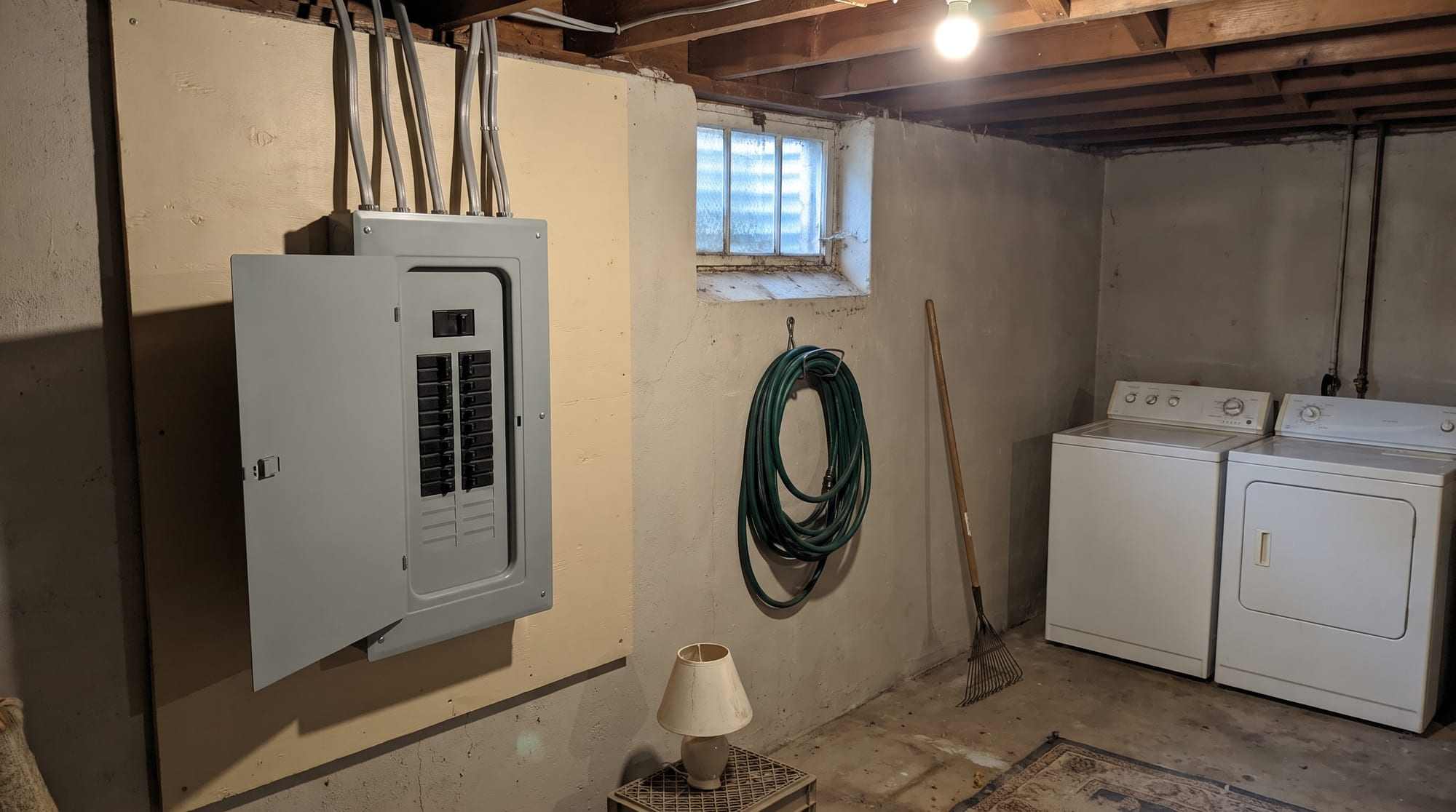
The panel takes the power the utility delivers and divides it into circuits, each behind a breaker sized to protect its wire. Houses wired before the 1960s often had 60 amps or less to begin with, and their panels now carry central air, a dishwasher, a microwave and, lately, a car.
An upgrade is not always about a bigger number. Sometimes the service is big enough and the panel is simply full, worn, rusted or one of the older panels with a known history. The first step is finding out which.
Signs Your Panel May Need Attention
- Breakers that trip, or fuses that blow, under ordinary use
- A fuse box, particularly one with a fuse swapped for a larger size
- No empty spaces, or rows of half-size tandem breakers squeezed in
- Rust or water stains on the panel, a frequent find in damp basements
- Warmth, buzzing or a burning smell at the panel: call without waiting
- Lights that dim hard when the air conditioner or the dryer starts
- A home inspector’s note about double-tapped breakers or the panel’s make
- Plans for an EV charger, an electric range, a heat pump or a hot tub
Service Size, Panel Space and Condition
Three different things get called a panel problem: the service size, meaning the amps the house can draw through the main breaker, the meter and the utility’s cable; the spaces for breakers; and the panel’s condition.
A load calculation, not the number of breakers, shows whether the service is big enough: it adds up the floor area, the fixed appliances, and the heating and cooling the way current code lays out.
The usual answers are a new panel at the same size, a larger service with a new panel, a subpanel that adds spaces where they are needed, or new breakers in a sound panel. A subpanel adds room, not capacity, and a larger service also involves the utility, which disconnects and reconnects the house.
Which fits depends on what the house runs now and will run in a few years.
Is 100-amp service enough for a house?
Often, in a house that heats and cooks with gas and has no electric car. A load calculation settles it. Add an EV charger, a heat pump or an electric range, and many 100-amp houses come out short, which is where 200 amps makes sense.
Should an old fuse box be replaced?
Fuses protect as well as breakers when each fuse matches its wire. The trouble is what years of use bring: a 30-amp fuse where a 15 belongs, too few circuits, no easy way to add GFCI or arc-fault protection. Home inspectors also tend to flag fuse boxes when a house is sold.
Are some older panels a concern?
Yes. A few makes and models from past decades have a known history of breakers that may not trip when they should. An electrician can identify one from its label, and replacing that panel is the usual advice.
Can a new panel go in a different spot?
Usually, though moving it adds work: every circuit has to be extended to the new spot, and the service cable rerouted. Current code keeps panels out of bathrooms and clothes closets and wants about three feet of clear space in front, so a panel in a closet is often moved during an upgrade.
Breaker Replacement and Whole-House Surge Protection
A breaker gets replaced when it won’t reset, sits loose on the bus, shows heat marks or trips under loads it used to carry, once the circuit itself checks out. The replacement has to be a type listed for that panel; one that merely fits the slot is not the same thing. AFCI and GFCI breakers can also add arc-fault or ground-fault protection to a whole circuit from the panel.
A whole-house surge protector mounts at the panel on its own breaker and sends voltage spikes to ground before they spread through the circuits. Many surges start inside the house as motors cycle on and off; bigger ones arrive on the utility lines in summer storms. It needs sound grounding, and it works alongside plug-in surge strips, not in place of them.
What Sets the Scope of a Panel Job
| Factor | Why it matters | What to note before contacting us |
|---|---|---|
| Service size now | Going up in amps usually means a new meter base and service cable, not only a new panel. | The number on the main breaker or the main fuse block. |
| Overhead or underground | It decides what changes outside the house and what the utility has to do. | Whether the wires come from a pole or up out of the ground. |
| Panel location | A panel that has to move, or sits in a finished wall, adds work. | Where it is and what is stored around it. |
| Fuses or breakers | A fuse box is replaced outright; a full breaker panel may only need a subpanel. | How many fuses or breakers, and how many empty spaces. |
| Grounding | A new panel usually means bringing the ground rods and the water-pipe bond up to current code. | Whether the water line into the house is now plastic. |
| Plans ahead | Sizing now for a charger, a heat pump or an electric range avoids a second upgrade. | What you expect to add in the next few years. |
Planning Around the Power Shutoff
- Clear about three feet in front of the panel, and the path to the meter outside
- The power is off for part of the job: keep the fridge and freezer shut and computers off
- A sump pump will be off too; in wet weather, have a battery backup or someone watching the pit
- Mention any medical equipment that runs on household power well before the work
- Note which breakers run the furnace, the sump pump and the freezer, so the new labels come out right