
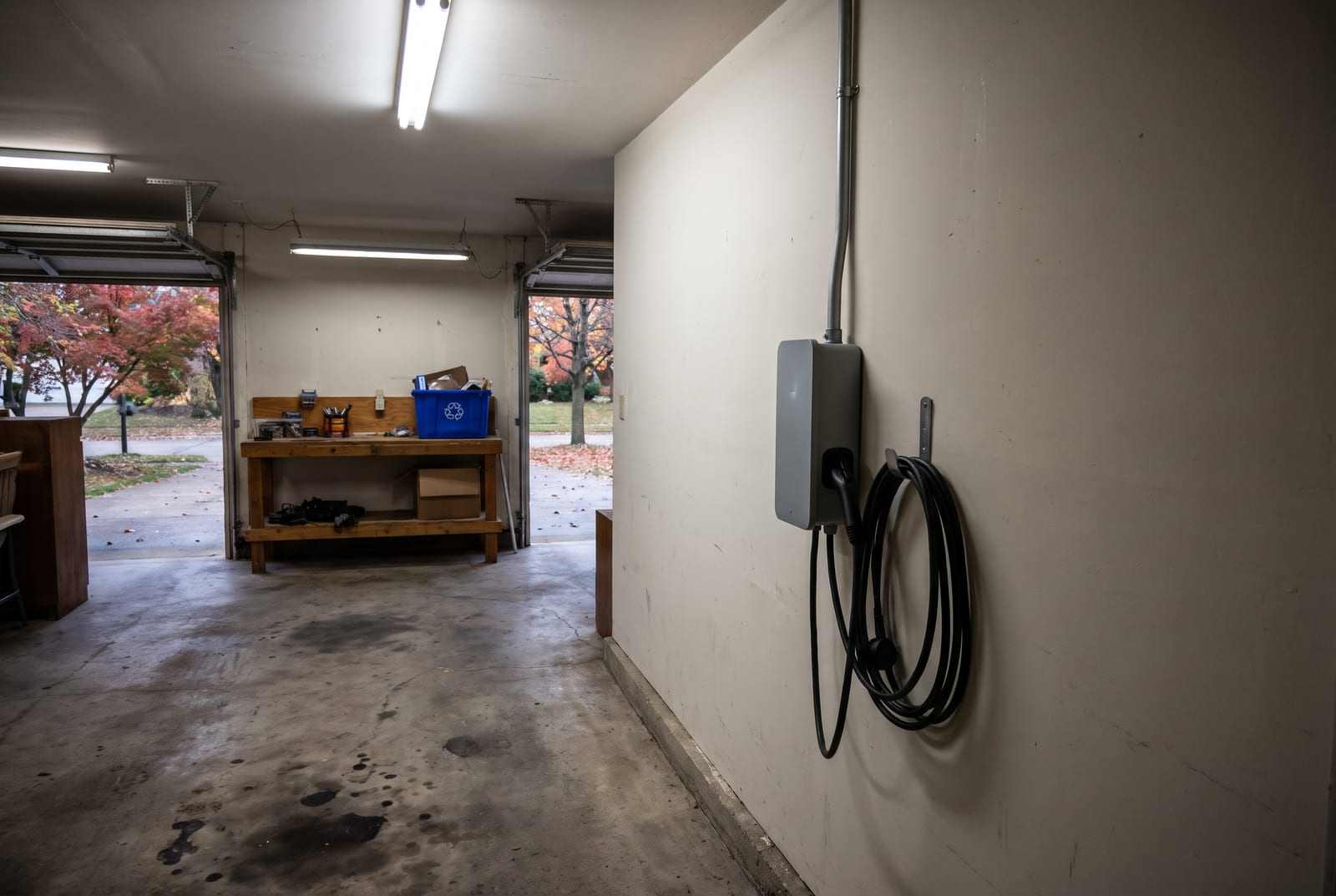
EV Charger Installation for Cleveland Garages and Driveways
What a Level 2 charger needs from the house: a circuit sized for it, room in the panel and a spot on the wall the cable can reach.
Most electric cars come with a cord for a regular 120-volt outlet. That Level 1 charging adds a few miles of range an hour, enough for short commutes and not much more. A Level 2 charger runs on 240 volts, like an electric dryer, and adds roughly 20 to 40 miles an hour, depending on the charger and the car.
Shoreway Electric installs home chargers in Cleveland, Lakewood and Parma. Most of the job is about the house: whether the service can carry another large load, whether the panel has room, and how the circuit gets from the panel to where the car parks.
Sizing the Circuit and Checking the Panel

A charger is a continuous load, so its circuit is sized at 125 percent of what the charger draws: a 32-amp charger needs a 40-amp circuit, a 40-amp charger a 50-amp circuit, a 48-amp charger a 60-amp circuit. That circuit feeds the charger and nothing else.
Before it goes in, a load calculation checks whether the service can carry it alongside the range, the dryer, the air conditioning and everything else. Many 200-amp services can. A 100-amp service sometimes can, mostly in houses that heat and cook with gas.
When the numbers are tight, there are choices short of a bigger service. Most Level 2 chargers can be set to draw less, and a load management device can hold charging back while the house is using a lot of power. When the service is simply too small, a panel upgrade comes first.
Setup Details That Change the Install
| Factor | What to check | How it affects the install |
|---|---|---|
| Panel capacity | The main breaker’s size, and which appliances run on electricity: range, dryer, water heater, air conditioning, heat. | Sets the charger’s amperage, and whether load management or a service upgrade comes first. |
| Panel space | Two empty spaces side by side for a two-pole breaker. | With no spaces left: tandem breakers where the panel is listed for them, a subpanel or a new panel. |
| Distance and route | How far the parking spot is from the panel, and whether finished walls or ceilings lie between. | Longer runs need heavier wire; finished rooms mean fishing cable or running conduit on the surface. |
| Where the car parks | An attached garage, a detached one or the driveway. | A detached garage needs its own feed; a driveway spot needs outdoor-rated equipment. |
| Charge port and cable | Which side the car’s port is on and how the car pulls in. Cables generally top out at 25 feet. | Places the charger so the cable reaches without crossing a walkway or the garage door’s path. |
| Plug-in or hardwired | Whether the charger plugs into a 240-volt outlet or connects straight to the circuit. | An outlet generally needs GFCI protection under current code and wears with use; hardwiring allows the higher charging rates. |
Is a regular wall outlet enough to charge an electric car?
For short daily drives, often yes: a car parked from evening to morning picks up a modest amount of range. Use a sound outlet on a circuit that serves little else, and plug the cord straight in, never through an extension cord, because hours of steady load find any weak connection.
Can two electric cars charge from one circuit?
Yes, with chargers built to share. Two compatible units on one circuit split the current between them, and either car gets the full rate while the other is idle. That avoids a second large circuit, which matters most when the panel or the service is tight.
What should I look for when buying a home charger?
A listing mark from a recognized testing laboratory, a cable long enough for the way you park, a housing rated for outdoor use if it will hang outside, and an amperage the house can support. Buying after the load check avoids a 48-amp charger in a house that can spare only 32. Scheduling apps need Wi-Fi that reaches the garage.
Does cold weather slow home charging?
It does. A cold battery accepts charge more slowly and gives back less range. An attached garage keeps the car out of the worst of it, and many cars can warm the battery and the cabin while still plugged in, so that energy comes from the wall rather than the battery.
Detached Garages and Driveway Chargers
Plenty of Cleveland and Lakewood houses have a detached garage at the back of the lot, at the end of a long driveway. Getting power there means a trench for buried conduit or, on some lots, an overhead run, and a larger feed may bring a small subpanel to the garage with its own grounding.
A charger by the driveway has to be rated for outdoor use and mounted out of reach of snow shovels and plows, with the plug holstered and the cable on a hook rather than on the ground.
Choices to Settle Before Installation
- Where the car parks, and which side its charge port is on
- Garage or driveway, and whether the garage is attached
- The number on the main breaker, and how many empty spaces the panel has
- The charger model, if you have one: its amperage, and whether it plugs in or is hardwired
- In a condo or a two-family house, which panel will feed the charger and whose approval the work needs
- Whether a second electric car is likely, so the first circuit can be planned with it in mind