
Lighting and Fan Installation for Cleveland Homes
Recessed lights, pendants, chandeliers and ceiling fans, and the switches and dimmers that run them, on an old box or somewhere new.
Most lighting work is one of two jobs: replacing what hangs from an existing box, or adding light where there was none. Shoreway Electric handles both, from recessed lighting and ceiling fans to pendants, chandeliers, stair lights and the switches that run them.
The fixture is the part you choose; how it goes in depends on the box, the wire and the switch behind it.
Replacing a Fixture or Adding a New One
A straight replacement happens mostly at the box. The old fixture comes down, the box is checked for a solid mount and a rating that suits the new weight, and the wires are looked over. In older houses that matters: wire above a ceiling fixture has often spent decades over hot bulbs, and its insulation can crumble at a touch. Cutting back to sound wire or splicing on a short new lead usually solves it; damage farther into the ceiling makes it a wiring repair first.
A new location needs a new box, cable fished from a power source and a switch, and sometimes a circuit of its own. Fishing cable through the plaster-and-lath ceilings of pre-war Cleveland houses is slower than through drywall and can leave small openings to patch; attic or basement access often saves cutting. When the panel has no room for another circuit, the lights become part of a panel upgrade conversation.

The Choices Behind Each Kind of Lighting Job
Each job brings its own decisions, best settled before buying the fixture.
| Project | What it involves | Things to decide | Good to know |
|---|---|---|---|
| Replacing a fixture | Old fixture down, box and wires checked, new one up on its own bracket | Size, bulb type, a dimmer or not | A smaller canopy can leave paint lines; a ceiling medallion hides them |
| Recessed lighting | Openings cut, cable run between lights and to a switch, often on a new circuit | Layout, trim size, color temperature, dimming | Spacing of about half the ceiling height is a common start |
| Ceiling fan in place of a light | A fan-rated box or brace replaces the light box; the fan is hung, balanced and wired | Blade span, downrod length, separate fan and light control | Blades at least 7 feet above the floor; 8 to 9 feet moves air best |
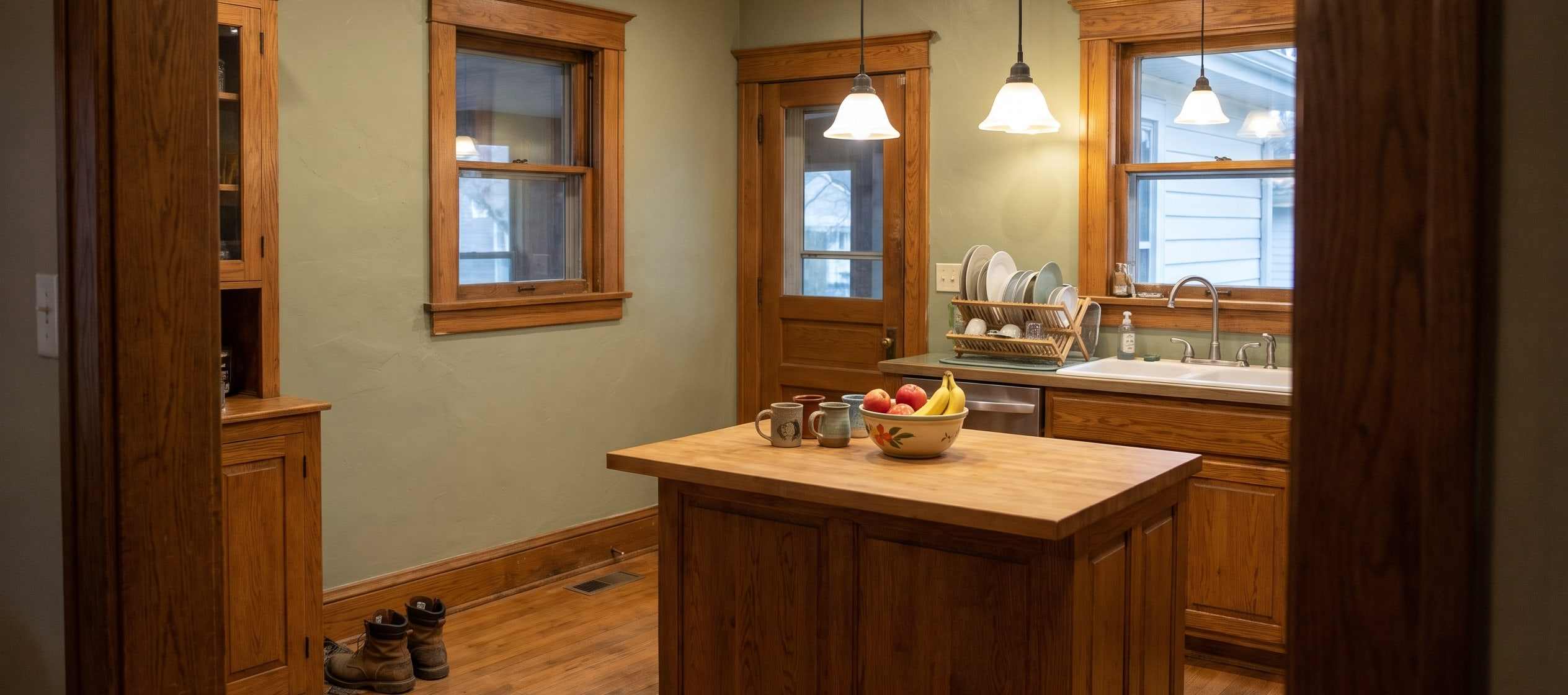
| Pendants and chandeliers | Hung, centered and supported, sometimes from a box moved over the table | Hanging height, weight, how many over an island | The bottom usually hangs 30 to 36 inches above a table |
| Stair and step lights | Wall lights or LED strip under a tread, switched at the top and bottom | How many, how bright, where the driver goes | A stair between floors generally needs a switch at each level |
Fan Boxes, LED Dimmers and Recessed Housings
Can a ceiling fan or a heavy chandelier hang from the box that is there now?
Not always. A light box only has to carry a still weight, generally up to 50 pounds when it is fastened to the framing. A heavier chandelier needs a box marked for its weight or support from the framing itself, and a fan, which pulls and shakes as it turns, needs a box listed for fan support or a brace between the joists.
Why do LED bulbs flicker or buzz on a dimmer?
Usually the dimmer was made for incandescent bulbs and cannot smoothly control the small current LEDs draw. Check that the bulbs are marked dimmable, then fit a dimmer rated for LED loads and set its low-end trim.
What does IC-rated mean on a recessed light?
IC means insulation contact: the housing can sit buried in insulation without overheating. One without the rating needs about 3 inches of clearance, which an insulated ceiling rarely gives. Under an attic, an airtight housing also keeps warm, damp air out of the attic in winter.
Will a smart switch work in an older house?
Often, with the right model. Many smart switches need a neutral wire in the box, and older switch boxes may hold only two wires: power down to the switch and the switched wire back. Some models work without a neutral; otherwise a new cable can bring one in.
Stair Lights and Switches at Both Ends

Stairs and long halls want light you can control from either end. Two three-way switches run the same lights from the top and the bottom of a stair, and a four-way switch between them adds a third spot, such as a landing.
Step lights set low in the wall put light where feet land, without glare. Many run at low voltage from a small driver, as does LED strip under a tread. The driver has to stay reachable, in a box or a closet, never sealed behind drywall, since it is the part most likely to need replacing.
Switch locations are easiest to settle while a wall is open; adding a three-way pair later means fishing cable between the two spots, which an old plaster stairwell does not make easy.
Details to Note Before Buying a Fixture or Fan
Four notes, made before you shop, settle most of the questions a new fixture raises:
- Ceiling height. Floor to ceiling, and whether it slopes. A low ceiling suits a flush-mounted fan; a tall or sloped one needs a downrod or an angled mount.
- Existing wiring. The age of the house, and any trouble at the old fixture: flicker, a warm switch, a tripping breaker.
- Switch or dimmer. One switch or two for the light, dimming or not, and any smart control in mind.
- Fixture weight. From the carton or the spec sheet. Over 50 pounds, or any fan, needs a box or support made for it.

Bathrooms add rules of their own. Near a tub or shower, fixtures must be rated for damp locations, or wet ones where spray reaches, and no pendant, hanging fixture or fan may sit just above a tub. A powder room with no tub or shower allows more, and a pendant beside the mirror lights a face from the side, with fewer shadows than one fixture overhead.
If the old fixture flickers or its switch runs warm, have that looked at first: it is an electrical repair before it is a fixture swap.


